A new generation of forward-thinking professionals is actively shaping possible futures. Among them is Nadja Skaljic, a lawyer and systems thinker whose work spans international policy, sustainability, and technology, with a focus on developing solutions for people, nature, and the future.
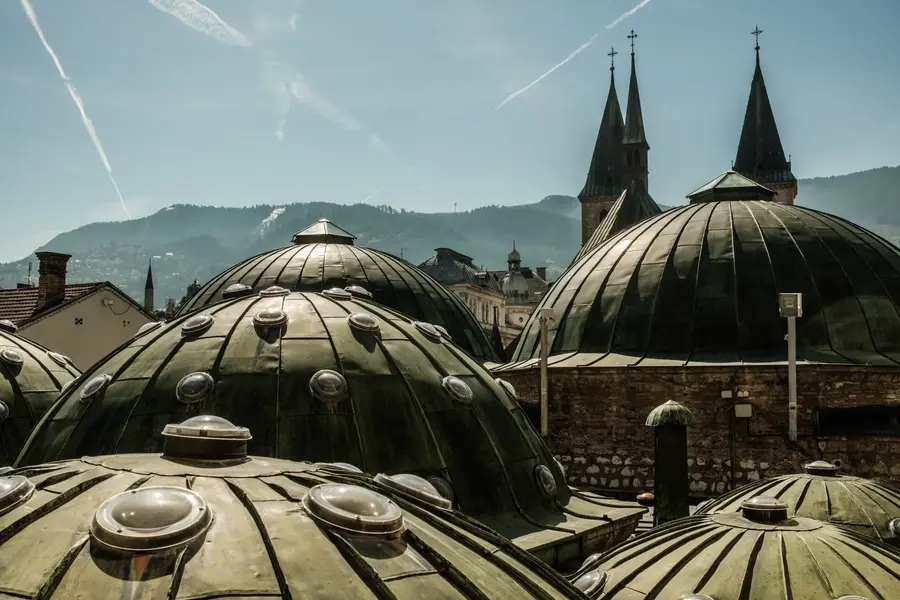
In this exclusive conversation, Skaljic—who lives and works in Switzerland—travels to Sarajevo to open the doors of the Bosniak Institute, a space closely tied to her family’s intellectual legacy. Set within a restored Ottoman hammam embedded in a contemporary architectural complex, the Institute reflects the layered histories that inform her worldview. Here, the discussion moves fluidly between geopolitics, technology, culture, and the evolving nature of intelligence itself.
What emerges is less a portrait of a career than a reflection on plural identity, the shifting meaning of taste, and Europe’s place in a rapidly reordering world—alongside a growing conviction that culture and humanistic values are not peripheral, but foundational to resilience in the Intelligent Age.
Skaljic also reflects on her nascent contemporary art collection, shaped by ideas of pluriversality and regeneration, and its dialogue with emerging technologies.
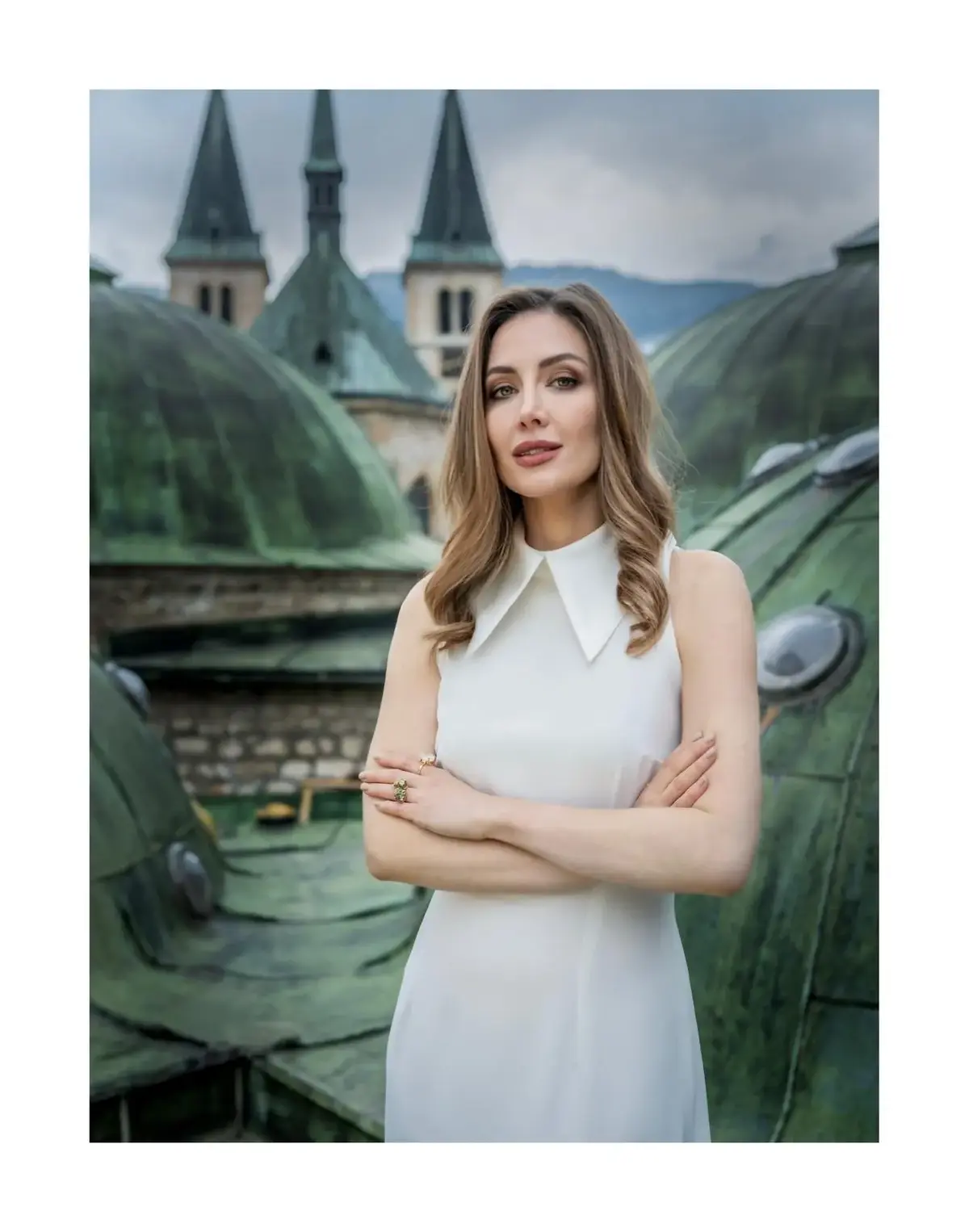
“Taste, in this AI age, is not merely preference. It is interpretation, selection, and responsibility. It reflects values, not just patterns, and carries social, cultural, and sometimes political consequences”
You grew up visiting the Bosniak Institute, and its founder, Adil Zulfikarpašić, who you knew as family. How did that environment of shape your understanding of history, culture and your place within it?
Few figures embody the layered histories and shifting currents of late 20th-century as vividly as Adil Zulfikarpašić. He was shaped by a lineage spanning pre-Ottoman, Ottoman, and Austro-Hungarian history. This continuity was carried forward through his education in Austria, his business success across global markets, and his life in Switzerland. In him, legacy and reinvention coexisted naturally. To me, he embodied that balance with clarity and ease.
He loved French and German philosophy, Flemish art, always impeccably dressed in Savile Row suits, he wore elegance of both mind and appearance lightly. It was never performative, but felt entirely his own. Beneath that ease was a disciplined mind with a clear sense of purpose. He spoke to me in German, giving those moments a certain closeness. I still remember a childhood visit when he brought us a Kangal puppy—at once a generous, playful, and quietly instructive gift, in keeping with his character.
Throughout his life, Adil-bey remained committed to preventing conflict among the Balkans’ ethnic and religious communities. This conviction was shaped by the family’s long history at the center of Balkan public life, as well as his own experiences during the Second World War, when he witnessed unspeakable crimes. The family always understood coexistence not as an abstract ideal, but as a historically lived reality—rooted in long-standing traditions of neighbourly relations, mutual accommodation, and a shared social fabric that requires renewal over time.
He worked to sustain frameworks where difference could endure without becoming destructive, prioritizing long-term stability over short-term gain, always commitment to peace, cultural preservation, and scholarship. During the 1990s, including the siege of Sarajevo, his political engagement remained strong, while he also continued collecting art, commissioning works, and building a significant archive.
Of particular interest to me was his focus on the émigré publications. Labelled Serbica, Croatica and Bosnica, they traced the intellectual and cultural trajectories of the region’s diaspora across continents—from Australia to Argentina, and even to early emigrants who left for Chicago aboard the Titanic. Together, they revealed a commitment to preserving thought, identity and memory beyond borders and disruption. At a time of destruction in the 90s, this became a parallel act of reconstruction.
In Adil-bey hands, this personal and the family’s history evolved into what is today the Bosniak Institute. More than a cultural institution, library, or foundation, it is a living space of identity, memory, and meaning across generations, supported by a collection of over 250,000 artefacts that continues to grow today. The Institute embodies a distinctly European sensibility: the ability to hold complexity without forcing resolution, moving between cultures, ideas, and contradictions while remaining anchored in broader civilizational continuity.
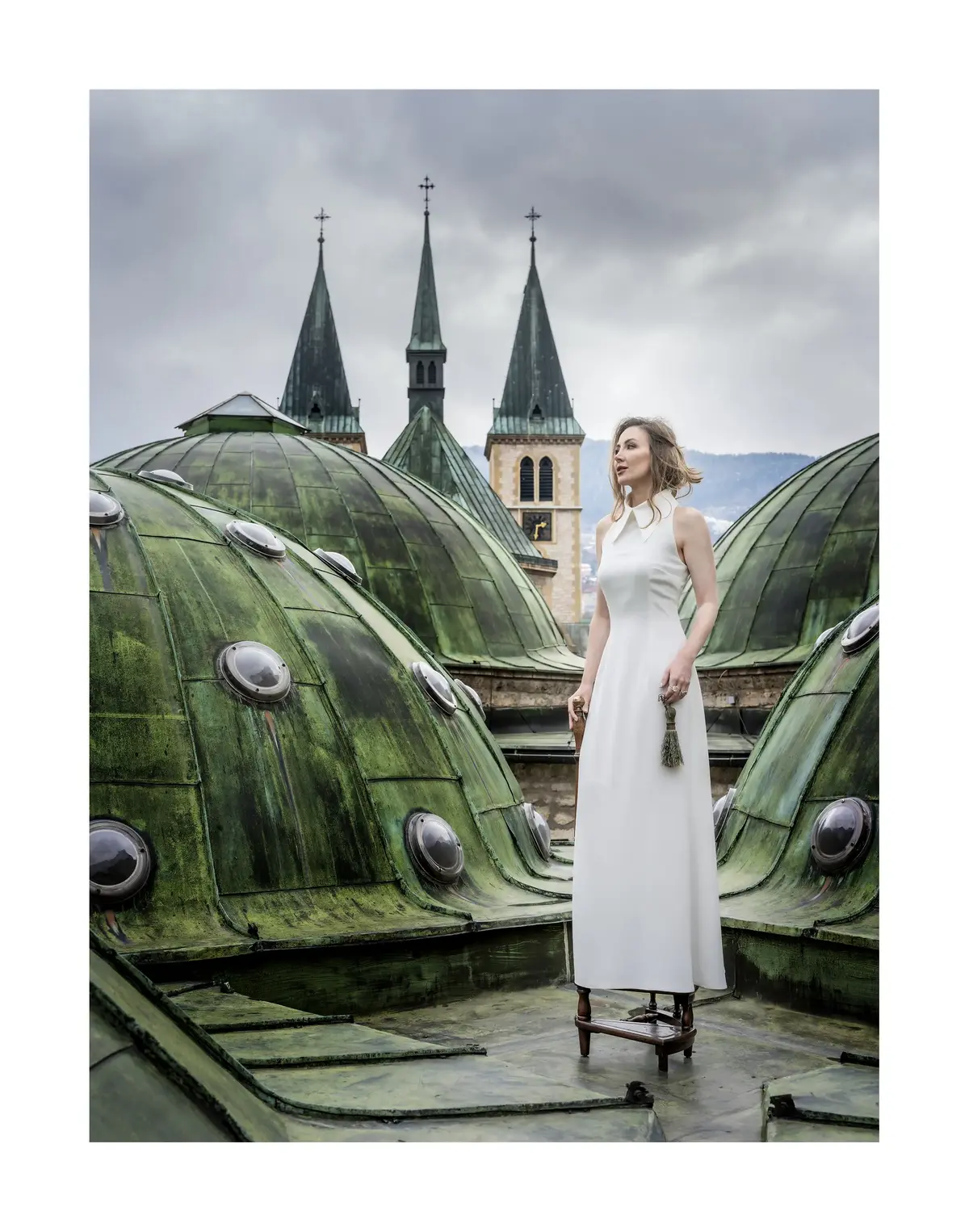
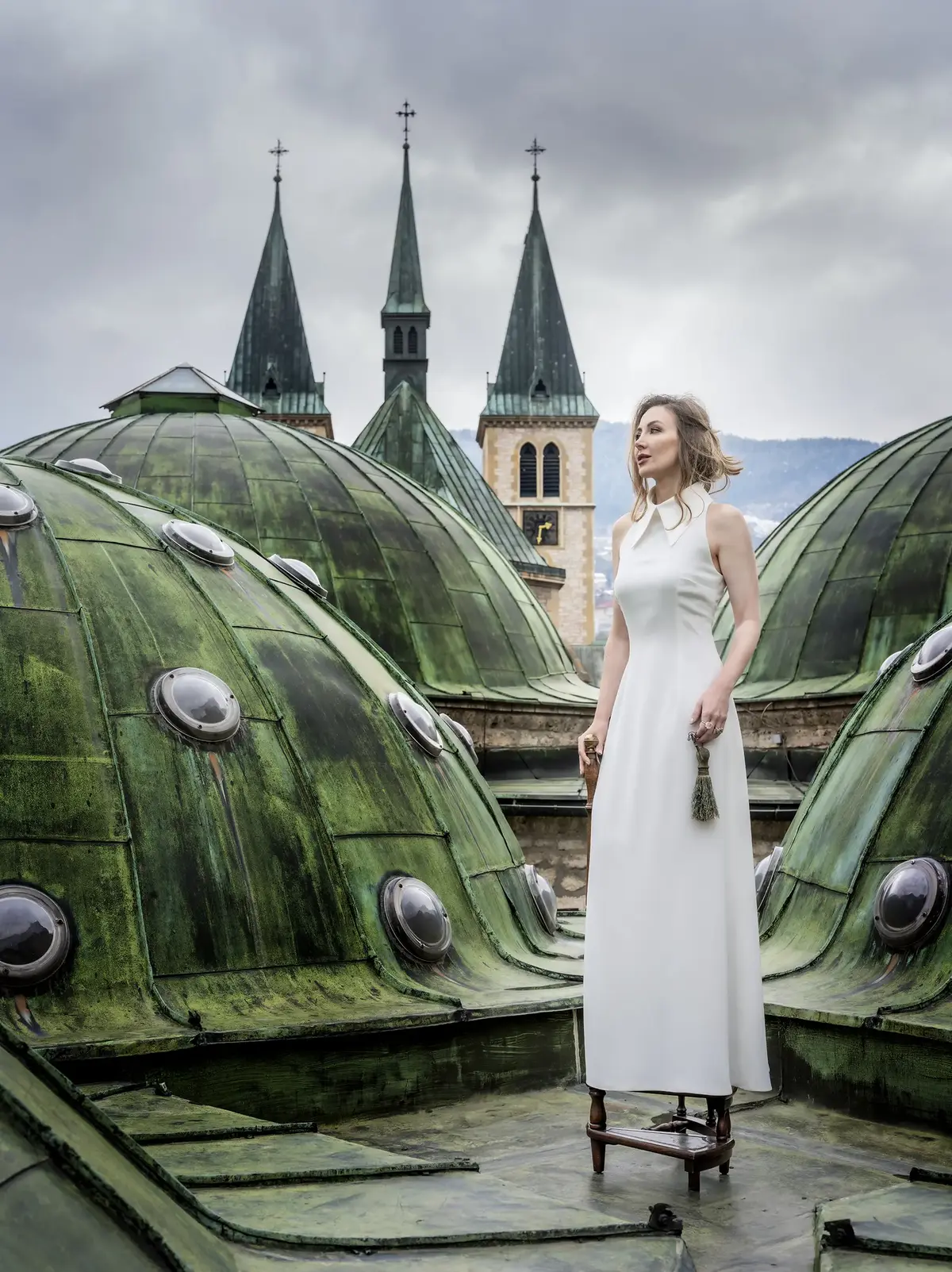
Photographed in Sarajevo, standing atop the historic 16th-century Ottoman hammam within the private foundation, with views toward the Cathedral of the Sacred Heart.
Is there an object or work within the Institute that left a lasting impression on you?
It is difficult to isolate a single piece. The Institute’s story began with the transformation of a 16th-century Ottoman hammam into a modern concert hall, later extended by a contemporary glass gallery and research building. It has always struck me as an act of quiet brilliance—distinctly Bosnian in spirit: adaptive, subversive, and expressive of both heritage and future. It is at once continuity and defiance.
The collections form a treasury of voices: tens of thousands of manuscripts and rare books, in Latin, Greek, Arabic, Persian, Ottoman Turkish, and other scripts —each a glimpse of this region’s evolution over centuries, seen through others’ eyes. Among them is a 14th-century Papal bull designating Bosnia terra medialis, a “land in between,” which reads less as a classification than as a lasting philosophical condition. The document also reflects the enduring presence of the Franciscans as long-standing custodians of the country’s spiritual and historical continuity, whose service remains revered across all communities.
One artefact I return to often is Mak Dizdar’s epitaph Zapis o zemlji, rendered in Bosančica, a medieval Bosnian variant of Cyrillic. It appears on a tapestry by Sabiha Berber, mother of painter Mersad Berber and an accomplished artist known for weaving and embroidery. In it, she weaves together Bosnian Christian tradition, Islamic mysticism, and the spirit of the medieval Bosnian kingdom—echoing the poetic inscriptions of stećci, stone funerary monuments that often reflect interconfessional coexistence and a reverence for nature.
And then there are the unexpected dialogues. A Louis XV-era Boulle marquetry clock by Renault of Paris, its gilded bronze and dark tortoiseshell catching the light, sits alongside a portrait of Tatjana Zulfikarpašić by maestro Safet Zec. It feels as though she keeps a quiet vigil over the passing hours and the collections. Such juxtapositions are everywhere throughout the Institute.
The Institute reflects the Balkans’ plural, multiethnic, multireligious heritage. Are such layered identities an enduring strength, or are they becoming too complex to be widely understood?
Plural, layered identities can be understood as a form of resilience. Regions like the Balkans have long existed at the intersection of cultures, languages, and faiths, producing a depth of experience that is both intellectually and socially rich. This layered Balkan pluralism has nurtured generations of original thinkers across disciplines, scientists, inventors, architects, artists, and writers, whose work has resonated far beyond Europe. Nikola Tesla remains one of its most emblematic figures.
The Balkans remind us that plurality is not an anomaly to be managed, but a condition to be understood and cultivated. Its model of pluralism reflects a lived experience of coexistence, adaptation, and continuity—tested through periods of conflict and war, and repeatedly renewed through processes of reconciliation. It is a model not easily reduced to simple terms, yet one that stands as evidence of a complexity which, in practice, has proven workable even under repeated, immense historical tests. The future of Europe as a whole will depend on whether complexity is embraced, reinterpreted and adapted to the Intelligent Age, a new civilizational era shaped by AI, longer lifespans, and collective intelligence, as the world moves beyond the industrial age.
What drives a lawyer and systems thinker, active in WEF Davos and Silicon Valley boardrooms, to pursue art collecting—building a collection that explores pluriversality and regeneration in dialogue with technology?
I’m used to working with frameworks, negotiations, and governance, so engaging with art is a continuation in a different register. Where law deals with structured systems, art allows for ambiguity, intuition, and questions of meaning often set aside in policy contexts. The collection I’m building reflects this approach. It is not tied to a single location—though one exists in Switzerland where I live—but spans projects across Europe, the United States, and China. It is my way to think responsibly about the future while staying grounded in ecological and human realities.
The commitment to pluriversality stems from the belief that no single system or narrative can fully capture our reality. This view is rooted in my experience of growing up across religious contexts and witnessing war, where meaning emerged through overlapping ways of seeing. It embraces “many worlds, many ways of knowing,” moving beyond a singular model of progress to include Indigenous, local, and alternative epistemologies alongside scientific and technological ones. In this sense, collecting becomes a way of curating an ongoing conversation across geographies, voices, and time—an approach reflected in artists I admire, like Petrit Halilaj, whose work explores the interplay of personal and collective memory.
My interest in regenerative art grows out of my work in sustainability. I value practices that move beyond raising awareness to act as forms of intervention—often involving collaboration with scientists, ecologists, and communities, and treating art not just as an object but as a process engaging with ecosystems, material cycles, and society. Artists that inspire me are veterans such as Agnes Denes, with works like Wheatfield — A Confrontation, where she transformed a Manhattan landfill into a wheat field, addressing food systems, land use, environmental ethics, and the relationship between urban development and nature. Similarly, John Sabraw collaborates with scientists to convert toxic waste into pigments used in paintings, turning environmental pollution into artistic material and making regeneration both conceptual and material.
Technology adds another dimension. It functions both as a tool and as a force that reshapes how we perceive, relate, and create. Artists like Refik Anadol, Sougwen Chung, Ryoji Ikeda, and Casey Reas show how computational and generative approaches can expand artistic language while deepening our understanding of interdependence and complexity in increasingly interconnected technological and ecological networks.
Ultimately, art is not separate from my systems-thinking mindset—it extends it. It gives me another lens through which to examine how systems take shape, how meaning emerges, and how multiple realities can coexist without being reduced to a single narrative.
When machines generate art, images, and ideas at scale, what happens to taste—and does human judgment become secondary, or more valuable because it cannot be replicated?
When machines begin to generate art, taste does not disappear—it is redefined. If algorithms can anticipate patterns, recombine styles, and simulate originality, they can approximate many of the visible outcomes of taste. But what AI cannot fully inherit is the situated, lived dimension from which taste emerges: memory, cultural context, ethical intuition, and the subtle judgments that come from experience and accountability to the world rather than to a dataset. I have found this distinction particularly clear in moments where I’ve been exposed to large volumes of machine-generated or algorithmically curated content. Faced with abundance, what stands out is no longer simply what is well-made, but what feels meaningful in a deeper sense.
Paradoxically, the more machines can generate, the more important it becomes to ask not only whether something can be made, but why it should exist at all. In my own experience working across frameworks that require evaluation and decision-making, this question increasingly underpins meaningful judgment. Taste, in this sense, is not merely preference—it is interpretation, selection, and responsibility. It reflects values, not just patterns, and carries social, cultural, and sometimes political consequences.
So rather than becoming secondary, human judgment becomes more visible: it must now justify itself in a landscape where replication is easy, but meaning is not. In this context, taste cannot be fully automated, it retains its value—not as a fixed authority, but as an evolving practice of attention, context, and responsibility.
“In the context of AI, critical judgement cannot be fully automated. It retains its value—not as a fixed authority, but as an evolving practice of attention, context, and responsibility”
If AI can replicate creativity, judgment, and even emotional tone, what remains uniquely human — and does that distinction still matter?
Human experience is embodied, finite, and accountable. We do not just generate ideas—we inhabit their consequences over time. Our judgments are shaped by memory, by relationships, by vulnerability, by the awareness that our choices affect others and ultimately return to us in ways that are not abstract. Even when machines can simulate empathy, they do not carry the weight of having to live with misunderstanding, loss, responsibility, or care.
There is also the dimension of intention—not as a technical parameter, but as something formed through biography, culture, and personal history. Human meaning is not only produced; it is discovered, revised, and sometimes contradicted by experience. That ongoing negotiation between what we believe, what we encounter, and what we become is difficult to reduce to pattern alone.
Does the distinction still matter? It matters less as a boundary to defend and more as a lens to clarify responsibility and meaning. In practical terms, AI may increasingly share the space of creation, interpretation, and decision support. But the question of who is accountable, who is affected, and what values guide the use of these systems remains fundamentally human. The presence of AI does not eliminate those questions—it amplifies them.
What is a position you hold about AI or technological development that might be unpopular in either policy or investment circles?
I’m comfortable taking positions that may be unpopular among colleagues, board members, and tech entrepreneurs, and this willingness to challenge consensus is often what adds value in those settings. A friend of mine, Javier Tordable, CEO of Pauling AI, refers to this as my “intellectual provocations.” One view I’ve found myself sharing frequently at board meetings over the past year is that efficiency and scale do not necessarily translate into sustainable value, as broader externalities—such as erosion of trust, concentration of power, and misaligned incentives—are often underpriced in the short term. This is where engagement with diverse practices in technology becomes important. I have introduced foresight methodologies across the environments in which I work, as I consider them an essential tool for anticipating change.
As board members, our fiduciary duty is to act in the long-term interests of the business, its shareholders, and other stakeholders, considering society at large. In biotech, this responsibility is often more complex, as advances in science increasingly push the boundaries of what is possible and introduce difficult ethical trade-offs. This requires prioritizing the management of risk, accountability, and proportionality over a purely speed-driven model of innovation. In my recent work with a Swedish longevity company, I saw how an AI system introduced as a support tool gradually began shaping decisions and narrowing how options were evaluated. The issue wasn’t a single failure, but the slow accumulation of reliance. By the time this shift became visible, the system was already deeply embedded, and changing course required far more trade-offs than if these implications had been addressed earlier. That experience is why the “move fast and scale first” mindset feels unconvincing.
In moments of systemic transformation, what responsibility do cultural institutions carry? Should they simply preserve, or actively shape the direction of technological change?
Both—and neither exclusively. Cultural institutions are at their most relevant when they refuse the false choice between preservation and shaping. Preservation without interpretation risks turning culture into a museum of itself; shaping without memory risks novelty without depth. Their real responsibility lies in acting as translators across time. They hold continuity while allowing for experimentation, offering contexts in which technological and societal change can be absorbed, questioned, and sometimes redirected. In that sense, they don’t just safeguard what has been—they quietly influence what comes next, by deciding what is worth remembering, what is worth testing, and what deserves to remain human in the process.
How would you like your art collection to evolve over time in the age of AI?
Less a collection in the traditional sense, and more a network of relationships—between works, ideas, and contexts. If it succeeds, it will not be defined by ownership, but by the conversations it enables and sustains over time. That tension, between building something lasting and ensuring it remains alive in meaning, is something I think about often. For me, the value of the collection lies not only in what is assembled, but in whether it continues to open up perspectives, connect people, and hold relevance beyond myself.