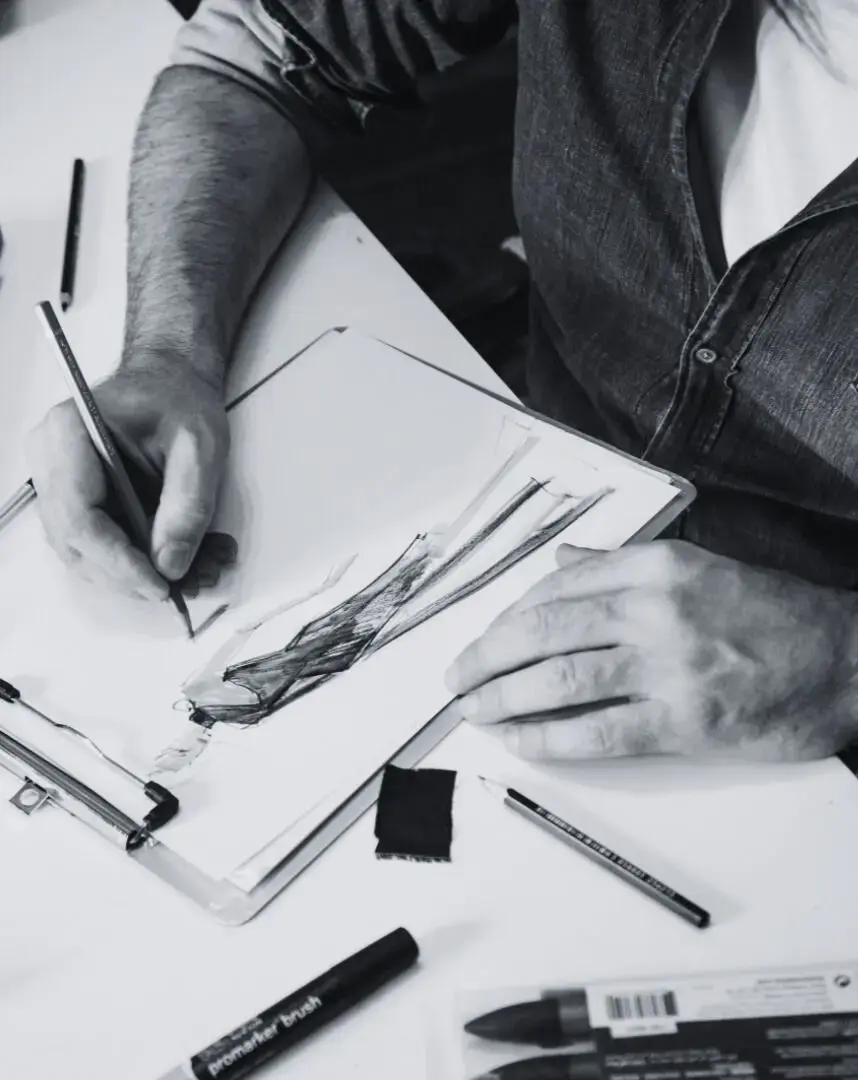
Fashion designer Igor Todorović is a visionary who merges art, craftsmanship, and philosophy. His journey, much like mine, includes years of living, working, and studying abroad before deciding to return home.
In this exclusive interview for The Collection Fashion edition, Igor reveals how he balances artistic expression with commercial success, why trends can often be 'toxic friends,' and how to help young creatives from our region find their place under the sun.
Zina:
Both of us share the experience of living and studying abroad. This strongly influences creatives because it shapes their style and values. Among other things, this experience taught me to value artistic quality in everything—be it marketing, design, or something else. Contextual depth, visual references, and a conceptual story are incredibly important aspects that also increase the monetary value of a product in the commercial world.
Take perfume, for example. It's a scented liquid that can vary in quality, but its purpose remains the same. A higher-quality perfume lasts longer and has more pleasant notes. However, a high-quality perfume with an interesting story and artistic value transcends the material—it becomes a part of your lifestyle, aligning with your identity, values, and interests. It becomes an expression of your personal style.
What are your thoughts on the importance of the artistic aspect in fashion?
Igor:
We indeed share a similar path—returning to our homeland after years abroad. That transition is a mixed shock; the values you adopt there differ from those here. It takes serious ethics and responsibility to adapt to what you see and live in.
Fashion inherently has a creative and artistic element. Creativity keeps you intrigued, while artistry pushes you to explore further.
Historically, fashion has always carried the weight of its artistic heritage. Great designers, whose legacies we now see in handbags, perfumes, or garments, were always oriented towards fine art.
To me, fashion is a discipline that merges elements of fine art, sculpture, and functionality. In a way, we sculpt bodies, paint pictures, and strive to make it practical. It's a process.
Zina:
Could you give an example of how this applies in your atelier?
Igor:
Right now, our atelier is focused on entering the Italian market. This year, we participated in Milan Fashion Week twice, which feels like a homecoming of sorts for me.
We also tried something new by organizing an event in Zlatibor in July to present our “Resort” collection by using a simple meadow to convey an ecological message.
Fashion has long grappled with sustainability as an issue, but since COVID, sustainability has become a significant part of the fashion agenda and an expression of responsibility within the industry.
Fashion demands listening rather than blindly following. When it becomes blind obedience, it becomes problematic because you end up adopting others' identities.
If a dress overpowers a woman, it’s the end—that dress becomes a 'toxic friend.' The central character in this story is the person wearing the dress.
Zina:
Speaking of listening and interdisciplinary connections, there’s currently a strong trend linking fashion and interior design. My first association with this synergy is Bauhaus. What’s your take on this connection, and why has it become so popular that even fast fashion brands now have home décor lines?
Igor:
Fashion is a lifestyle and a reflection of societal trends. Historically, fashion has always mirrored social issues or achievements.
During COVID, as we were all confined to our homes, people began thinking about home aesthetics. Fashion’s mentality is outward-focused—it’s a shell you wear.
The realization of interior design as a crucial segment of one’s style was a natural progression. For too long, in our region, we valued only outward appearances. It’s encouraging to see we’re now thinking about inner manifestations as well.
Zina:
Trends have always existed, and I believe they are important as they represent an era and everything associated with it. However, trends now change at a dizzying pace. Could you highlight a moment in history that accelerated this speed, aside from the Industrial Revolution?
Igor:
Fashion in the 1990s experienced a seismic shift under Anna Wintour’s leadership at Vogue. The iconic moment when Christian Lacroix met denim changed everything.
Anna opened Pandora’s box, and fashion began rapidly creating trends. Today’s fast-paced trend turnover creates ecological problems with the sheer volume of production and consumption. Everyone has opened their closet at some point and thought, “I own too many unnecessary items.”
Post-COVID, the industry has started to recognize what I deeply value—craftsmanship, longevity, and continuity.
Armani, whom I like to call the gray-haired titan of fashion’s Olympus, once said it’s inappropriate for a jacket from a previous season to leave the store only to have a similar one appear for the new season. He understood that the beauty of his work is undeniable and timeless.
Zina:
Speaking of the gray-haired titan of Olympus, I’d like to ask you about his future successors. It’s inevitable that higher education abroad offers much better opportunities. Many young people from our region still don’t have access to those opportunities—it remains a luxury, almost a status symbol. Do you think there are institutions in our region that promise that level of education, or is it rather some other type of initiative?
Igor:
Yes, that’s true. I would say we have exceptional individuals, rather than a specific establishment. Those individuals are fantastic but need support, understanding, and a lot of encouragement to continue their journey. Across the region, we have numerous designers, painters, and artists who emerge and achieve notable success abroad. However, they are often misunderstood in their own environment. That’s nothing new or unusual.
On the other hand, we must face the fact that we haven’t utilized our vast heritage adequately. I believe now is the time to focus on that, giving new generations the chance to develop and improve while simultaneously realizing how often we fail to use our heritage properly—in every sense.
For example, from a craftsmanship perspective, we have an extraordinary 'playground' in the form of Montenegro’s stunning traditional costumes.
Art must be rebellious to bring about change. Rebellious not in a destructive way, but in a creative, innovative manner—pushing beyond the boundaries we currently live within.
One must be open to continuously improve their knowledge. I hope one day our region will see the emergence of such a school, particularly for fashion, that will guide and shape people in the right direction. In our atelier, we always have an apprentice, and I genuinely celebrate the success of those young people who often differ entirely from my aesthetic. Yet, they are so authentic and poetic that the entire team provides full support.
Zina:
How can we support young people in our region? Is it through a platform, event?
Igor:
Events are pop-up projects—they happen, and often there is no follow-up. I believe it should be a platform rather than an event.
Such a platform should allow them to engage with textiles, gain practical experience, and understand what it means to create and persistently work in this field. Brands can be established easily, but the strength of a brand lies solely in its longevity.
Among the youth, there’s a lack of awareness about turning creativity into reality. There’s no bypass between an idea, a finished product, and its market placement. These are the elements of a platform I would introduce.
Zina:
When you talk about the bypass from idea to realization, tell me about the bypass between artistic value and commercialization. It can be a huge challenge. How do you find the golden middle ground between artistic and commercial value?
Igor:
The golden middle ground, like in life, is balance. Balance is a sublife of altruism and egocentrism. Altruism is the commercial side; egocentrism is the artistic side. From your ego, in a positive sense, you create art that sometimes lacks pragmatism. From altruism, you create something more accessible.
There are moments in our work when everyone feels the need to create something extraordinary, something exceptional. However, I remember what my school dean once said: “You can make a dress that resembles the Eiffel Tower. But can the person wearing that dress hug their loved ones in it? Can that person bend down to pick up a dropped lipstick? Can they run toward a bright future? If you’ve achieved that balance—where you’ve egocentrically created an Eiffel Tower yet altruistically provided those essential human values—then that is true success.”
Gallery